

Citizens’ Guide to Resisting Would-be Autocracies

What is happening to the “Blessings of Liberty” conferred by the Constitution?
Democratic Backsliding
Many people, including journalists, and political science and government experts around the world, have claimed that President Trump has transformed or is in the process of transforming the United States government from a liberal democracy into an autocracy. The United States served as a model of democratic government for almost 250 years.
The US, however imperfect it may be, was the leading world power since World War II, based not just on its economic and military might but also on its championing of the ideals of democracy.
So, the question arises, what can Americans who believe in democracy, and who believe autocracy is taking hold, do to stop, or live through, the unwelcome democratic backsliding?
Autocracy and Soft Authoritarianism
The US is not living under a dictatorship, regardless of what some may claim. It’s important to get our terms right as understanding where we are and where we may be going is critical to finding appropriate solutions and strategies.
The Cambridge Dictionary defines autocracy as:
government by a single person or small group that has unlimited power or authority, or the power or authority of such a person or group
As of June 15, 2026, we are not there yet. But Donald Trump and his administration have taken and threatened a series of steps which could lead us there.
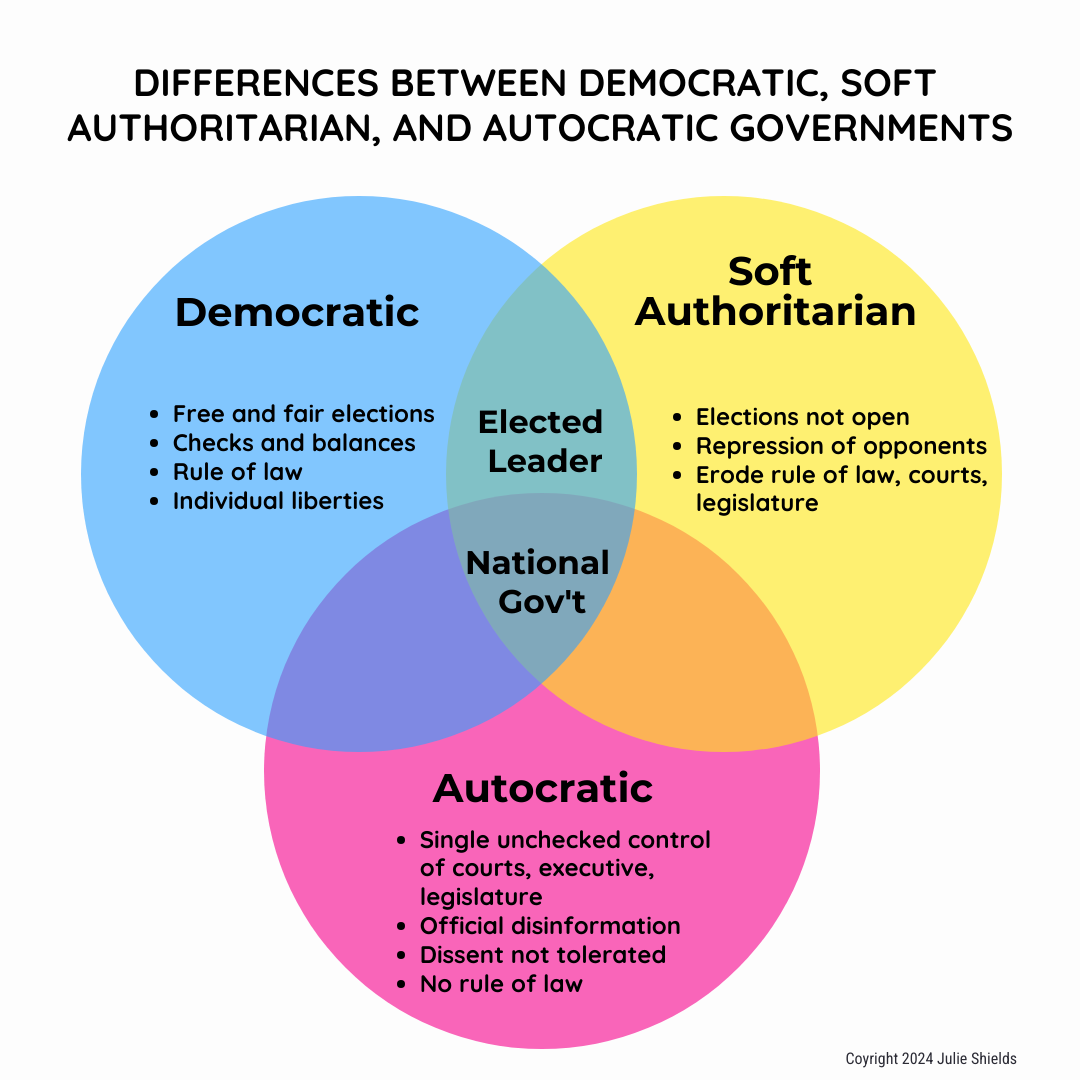
Diagram shows differences between and overlap of Democratic, Soft Authoritarian, and Autocratic governments.
Power Grabs and Exhausting The Public
Since day 1 of Trump 2, the administration has extended and attempted to extend executive power far beyond anything seen before in the US. This usurping of power and incursions into the separation of powers have worried many. See for example, The Conversation’s article: “What’s behind Trump’s flurry of executive action: 4 essential reads on autocrats and authoritarianism”:
“Administration officials and Trump allies have described all this action as a ‘shock and awe’ campaign intended to ‘flood the zone.’ Translation: It’s both an effort to demonstrate autocratic power and an effort to overwhelm and exhaust people who might resist the changes.”
It’s a lot. It’s fast and furious. It’s hard to make sense of anything and everything all at once.
But there are actions those who want to stop movement into soft authoritarianism and autocracy can take, individually and collectively.
What To Do
The first step to tackling any problem is always to identify it. For people who believe the threat to democracy is real, acknowledging the situation without emotion is the first step. They must come to terms with the unthinkable. It can happen here.
Next, don’t give in to the shock and awe strategy. Yes, it’s all exhausting and depressing. But it’s important to resist the changes a would-be autocrat seeks to impose, and quickly.
Understand the Game
Would-be authoritarians/autocrats aim to strengthen and consolidate power while weakening government institutions.
The Authoritarian Playbook lists seven steps wannabe authoritarians use to secure power:
Politicizing Independent Institutions
Spreading Disinformation
Aggrandizing Executive Power
Quashing Dissent
Scapegoating Vulnerable Communities
Corrupting Elections
Stoking Violence.
Advocates for Democracy, the Rule of Law, Separation of Powers, guardrails on government constitution, norms and standards, and against executive corruption should devote great energy to resisting power grabs, illegal actions, and erosion of the checks and balances set up by the Constitution. Lack of success in resistance at this stage will bring a country to the next stage.
In the next stage, it will become harder to resist change or illegality. By then, the consolidated government will have become more powerful, with checks and balances removed. Democratic protections and freedoms such as freedom of speech, freedom of the press, the rule of law, and an independent judiciary and legislature, will have weakened and in some cases disappeared.
Resistance in Phase 1
Congress and our courts control the fate of democratic institutions and the type of government the US will have. Under the Constitution, they provide checks and balances to the Executive Branch.
If unqualified, partisan loyalists are confirmed and take actions in support of the President’s agenda rather than the people’s, democratic policies and protections will be eroded as they were in Viktor Orban’s Hungary.
6 Steps to Protect Democracy
Contact Republican Senators and Representative on all media and in their congressional offices asking them to oppose the policy, action, or nominee to which you object.
Talk to Republicans, MAGA, and others who don’t see things the way you do about the issues you care about if you can. Without arguing. Try to exchange ideas. Don’t give up on our country. Accepting division will foster more of it.
Support those who call out and oppose authoritarian-leaning, democracy-weakening actions, including independent media, whistleblowers, and the wrongly accused. Facts and truth are in short supply under authoritarians: it’s imperative to keep them circulating.
Mobilize and speak out. Don’t normalize anything. Do something. Mass protests helped Hungary shake the yoke of Victor Orban. Show up for democracy.
Show up at the polls and encourage others to do the same. Hungarians voted in massive numbers, counteracting the attempted restrictions of free and fair elections.
Build grassroots coalitions. Start with your neighbors and forge a defense against democratic backsliding.
Grappling With the Unthinkable
As we pass through the stages of grief or learning to accept the previously unthinkable, we may do some of the following actions that don’t serve our purpose. Getting through this process sooner rather than later is imperative if we are to begin acting rather than complaining, worrying, venting, arguing, or just being depressed.
All of the coping strategies listed below are normal. Given the comfort many of us have lived in our whole lives, we are not conditioned to dealing with constitutional crises. But if we’re going to be comfortable going forward and live in a country with the freedoms we love, we have to meet the moment.
What Doesn’t Work
Strategies to Avoid
Post-mortems on the last few elections, railing against mistakes made by Joe Biden, Kamala Harris, Barack Obama or the Democratic party.
Instead: Use past mistakes to help form a useful strategy going forward.
Scrolling through, or posting on, social media; watching TV or videos, or listening to podcasts, to confirm what you think and fear.
Instead: Write letters to Senators and try to talk to and connect with some Republicans and MAGA with respect and calmness (not always easy; develop strategies for this effort).
Repeatedly getting angry about the media’s treatment of what’s happening.
Instead: Channel anger into thoughtful action. Search out and support reliable independent media to learn what’s going on; check out local news.
Reacting to and over-focusing on inflammatory posts or news that “pushes your buttons”.
Instead: Fact check the claim, especially if it appears on social media. If it’s false, this is not a reliable source, and you can remove it from your info diet. If necessary, calmly and with facts, refute the claim. Then move on.
Feeling helpless, that nobody can do anything about the changes, that they are inevitable.
Instead: Organize. Reach out with a purpose. Acting collectively as well as individually can bring pressure upon those who can make change happen.
For More Information
Check out Marc Elias’s Ten Things We Can All Do To Protect Democracy.
Read Psychology Today’s Ten Ways To Cope With Big Changes.
Read Protect Democracy’s The Authoritarian Playbook.
Read Groundtruth’s Democracy Undone: The Authoritarian’s Playbook.
Use this Contact Information to send a letter to a senator or representative to outline concerns.

We must create a semblance of order amid the chaos.
