

Emergency No-Bid Contracts Skyrocketing: Political Patronage On the Rise?
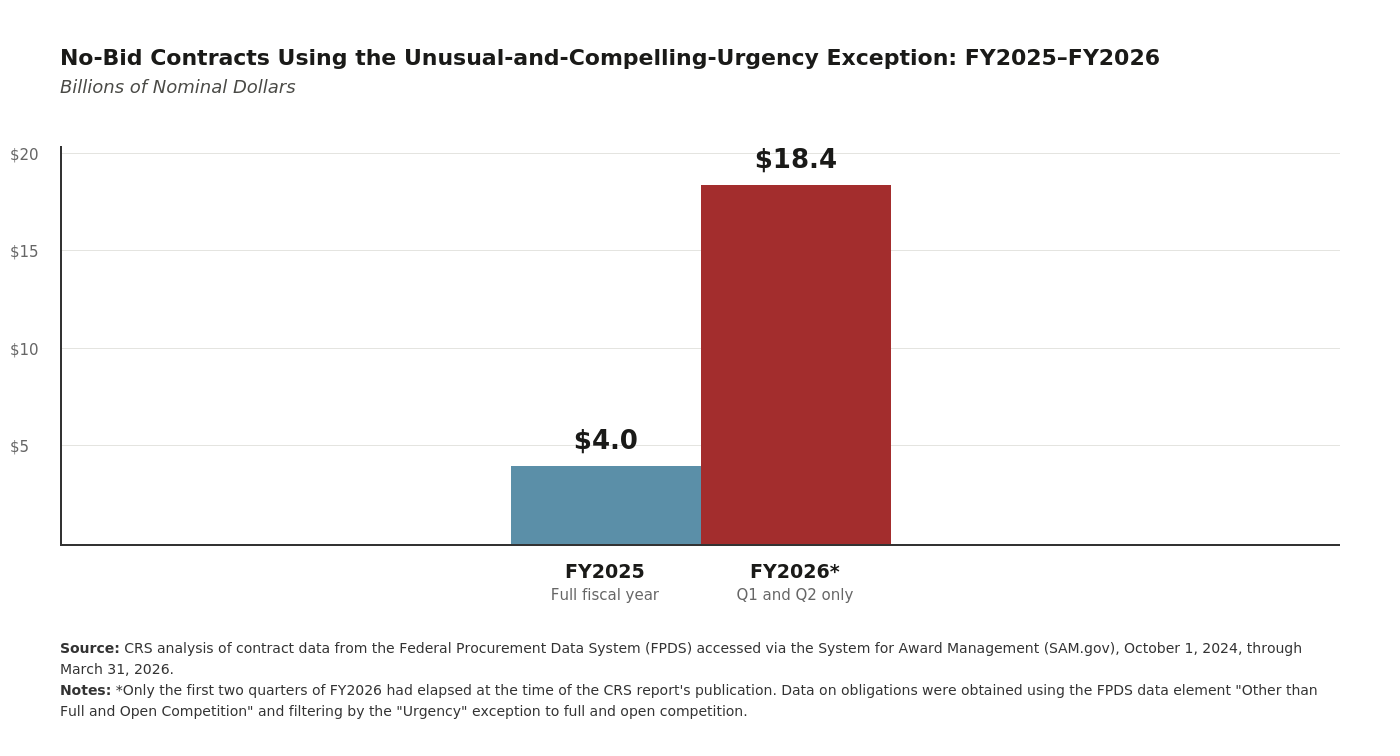
Prolific usage of urgent no-bid contracts FY 2026
Emergency No-Bid Contracts Soaring In 2026
In the first half of the 2026 fiscal year, the US government awarded 18.4 billion dollars in no-bid contracts under what is known as the “emergency exception.” This is more than four times the total amount spent in all of 2025 on emergency no-bid contracts, on pace to reach peak Covid spending dollar amounts.
No-bid contracts can have a legitimate basis, and have also been associated with political patronage awards. No-bid contracts, also known as single-source or sole-source contracts, were prevalent during the spoils system era in the US in the late 1800’s. When used improperly, they can become political patronage and waste taxpayer money.
Democracies Disfavor No-Bid Contracts Except in Rare Circumstances
Democracies, the United States, and the US Congress have historically disfavored no-bid contracts due to the risk of corruption and the risk that election winners may reward political patrons or insiders by awarding contracts that are not in the interest of the country or taxpayers.
Congress has stated that competitive bidding for government contracts encourages lower prices, and ensures higher quality goods and services, increased innovation, and greater public trust in government.
According to the legal encyclopedia American Jurisprudence:
The purpose of requiring governmental entities to conduct competitive bidding is to eliminate favoritism, fraud, and corruption; to avoid misuse of public funds; and to stimulate advantageous marketplace competition. Such competitive bidding statutes are intended not only to ensure that the awarding authority obtains the lowest price among responsible contractors but also to establish an open and honest procedure for competition for public contracts.
Political patronage contracts were a hallmark of the inefficient, corrupt spoils system era. As a result, US law provides for the use of no-bid contracts only in special circumstances.
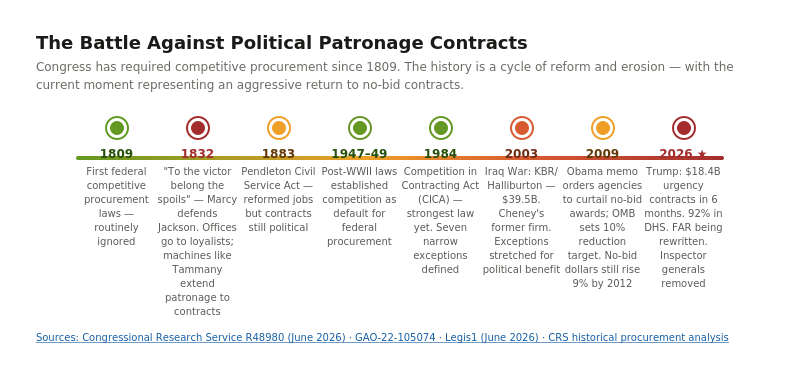
US law has disfavored no-bid contracts and political patronage awards for over 200 years.
Urgency Exception to Prohibition Against No-Bid Contracts
US law provides seven exceptions for when the federal government can use a no-bid contract. The second Trump administration has repeatedly made use of what’s known as the “emergency exception”:
Unusual and compelling urgency where the Federal Government would be seriously injured unless the agency is permitted to limit the number of sources from which it solicits bids or proposals. The agency must request offers from as many potential sources as is practicable under the circumstances.
In the first half of the fiscal year, the Trump administration has relied on the unusual and compelling urgency exception in awarding costly no-bid contracts. Ninety-two percent of the dollars awarded under the emergency exception went to a single agency, the Department of Homeland Security (DHS).
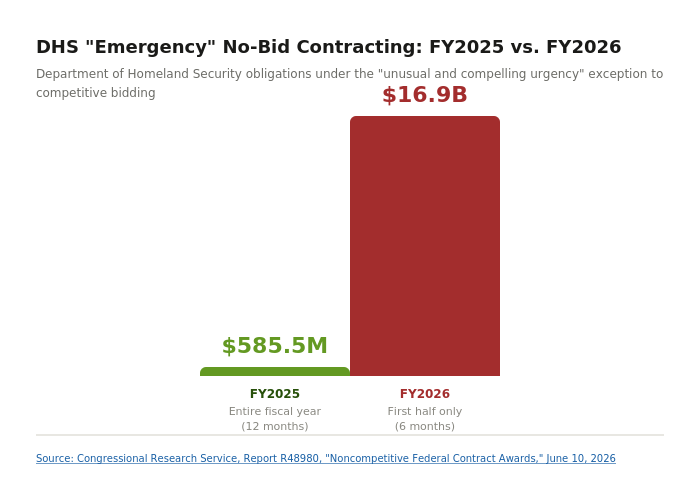
92% of emergency no-bid contract funds have gone to the DHS in first half of 2026.
In the past, the US government has exercised this exception for situations like the COVID-19 public health emergency and hurricane emergency response.
The 2026 DHS no-bid emergency contracts emerged through a different process. Upon taking office, President Trump declared a national emergency at the southern border. In awarding contracts without competition and without providing information about the vendor and cost of the contract, DHS relied on the declared border emergency as part of the urgency justification.
Critics argue that this “emergency” is in effect an administration policy choice rather than a clear natural disaster or pandemic in need of immediate action. The public does not seem to agree that an emergency exists at the Southern Border justifying more spending on ICE. A March 2026 PRRI poll found that just one third of Americans have a positive view of ICE officers and just 35% of people rate President Trump’s handling of immigration favorably.
Emergency No-Bid Contract Policy Expanding
Outside of the DHS/ICE arena, the administration has expanded the emergency no-bid contracts exception to making emergency preparations for semiquincentennial events and parties and repairs to the Reflecting Pool for the 250th celebration. The 250th celebration would seem at first glance to be a foreseen and foreseeable event. Under the federal procurement rules:
Contracting without providing for full and open competition shall not be justified on the basis of a lack of advance planning by the requiring activity.
Some of these emergency no-bid contracts went to companies owned by donors of the president and allies of the administration. For example, Greenwater Services, owned by a Trump donor and twice-convicted felon according to the Wall Street Journal, secured the contract to install an experimental water purification system in the Reflecting Pool. Greenwater had previously received just one other federal contract, also awarded by the second Trump administration. Neither Greenwater project seems to have worked.
Similarly, the contract to recoat the Reflecting Pool went to Atlantic Industrial Coatings, a company with no federal contract record that had done work on President Trump’s country club pool in Virginia. The National Park Service warned that this contract would give Atlantic a 20% profit, much higher than the customary rate, adding roughly $850,000 to the normal pricing. This project, too, has been unsuccessful.
These two “urgent” no-bid awards to repair the Reflecting Pool show why the competitive bidding process is preferred.
Further, some DHS ICE no-bid contracts continue for five years, although the urgency exception generally limits no-bid contracts to just one year. In rare circumstances, the head of the agency can determine that exceptional circumstances apply and extend the one-year term, which DHS has done.

Taxpayer dollars wasted by political patronage
No-Bid Contracts A Tool of Authoritarians
Because of the potential for abuse, democracies seek to control the use of no-bid contracts. In contrast, authoritarian or autocratic governments have awarded massive no-bid contracts to insiders and political patrons. In essence, government spending becomes a closed system, open only to favorites and supporters. Vladimir Putin, for example, awarded lucrative government contracts to a group of insiders, who then put the money back into the system, which continually reinforces itself, and closes out the rest of the country.
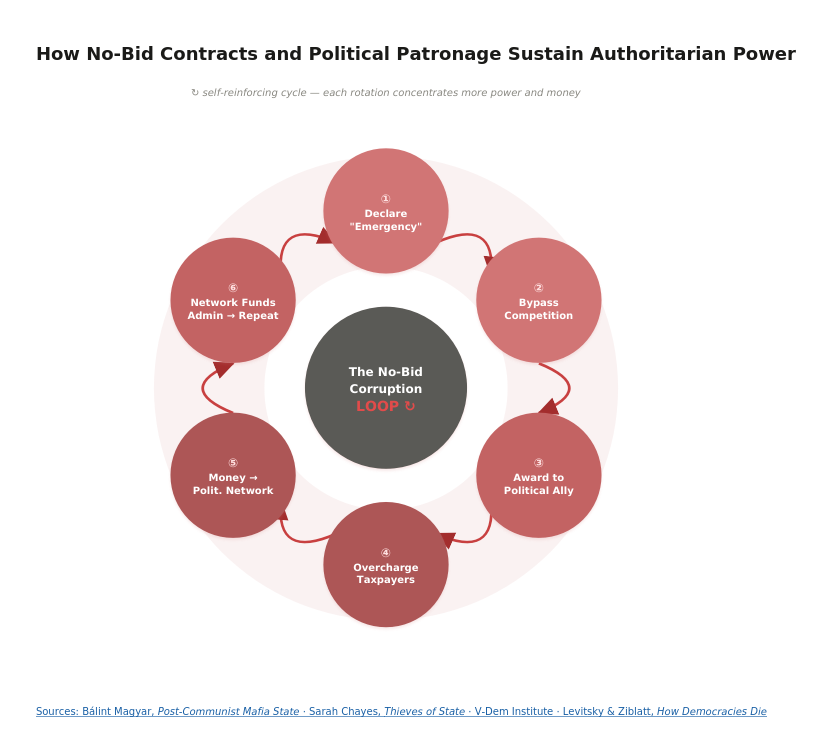
Authoritarians use no-bid contracts to consolidate power.
The United States’ increasing reliance on emergency no-bid contracts, some of which have gone to political donors and insiders, rings all sorts of warning bells. Emergency no-bid contracts can serve the interests of a few over the interests of the country. They should be used sparingly and with care and transparency where possible.
Want to Know More? Check Out:
No-Bid Contracts Explained: Uses, Risks, and Benefits
No-Bid Contracts Invite Government Corruption
Firm Tied To Trump Donor Got No-Bid Contract To Clean Reflecting Pool
ICE, Inc.: The Top Companies Profiting from Trump’s Immigration Crackdown
Trump’s White House Ballroom Vanity Project Was Built on a Secret $500 Million No-Bid Contract
From Corruption to State Capture: A New Analytical Framework with Implications from Hungary
