

United States Corruption Rising: The World Has Noticed
Perception of United States Corruption Skyrocketing
“It’s all the same. All politicians are corrupt. Everybody does it.”
Have you heard that one? It’s not true. And United States corruption is on the rise.
Some governments are more corrupt than others and some leaders are more corrupt than others. Denmark’s government is consistently viewed as the least corrupt in the world, with a score of 89 out of a possible 100, according to Transparency International's most recent Corruption Perceptions Index (CPI).
The CPI measures perceived public-sector corruption and is not a measure of corruption. Still, it’s the leading global indicator of public-sector corruption and flags evidence of increase or lessening of corruption each year. The CPI uses a 0–100 scale. A score of 0 means very corrupt, and a score of 100 very clean.
For reference, Somalia and South Sudan were the most corrupt in 2025, with scores of 9. The US received a 64 in 2025, clocking in as 29th least corrupt out of 182 countries, with a record low score indicating recent perceived surges in corruption.
The American public agrees that unprecedented corruption is occurring in the United States. In a September 2, 2026 Gallup Poll of American Independents, Republicans, and Democrats, 89%, a record high, viewed US government corruption as widespread. For the first time, the US ranked the highest in perceived corruption of all 38 OECD (high-income democratic) countries.
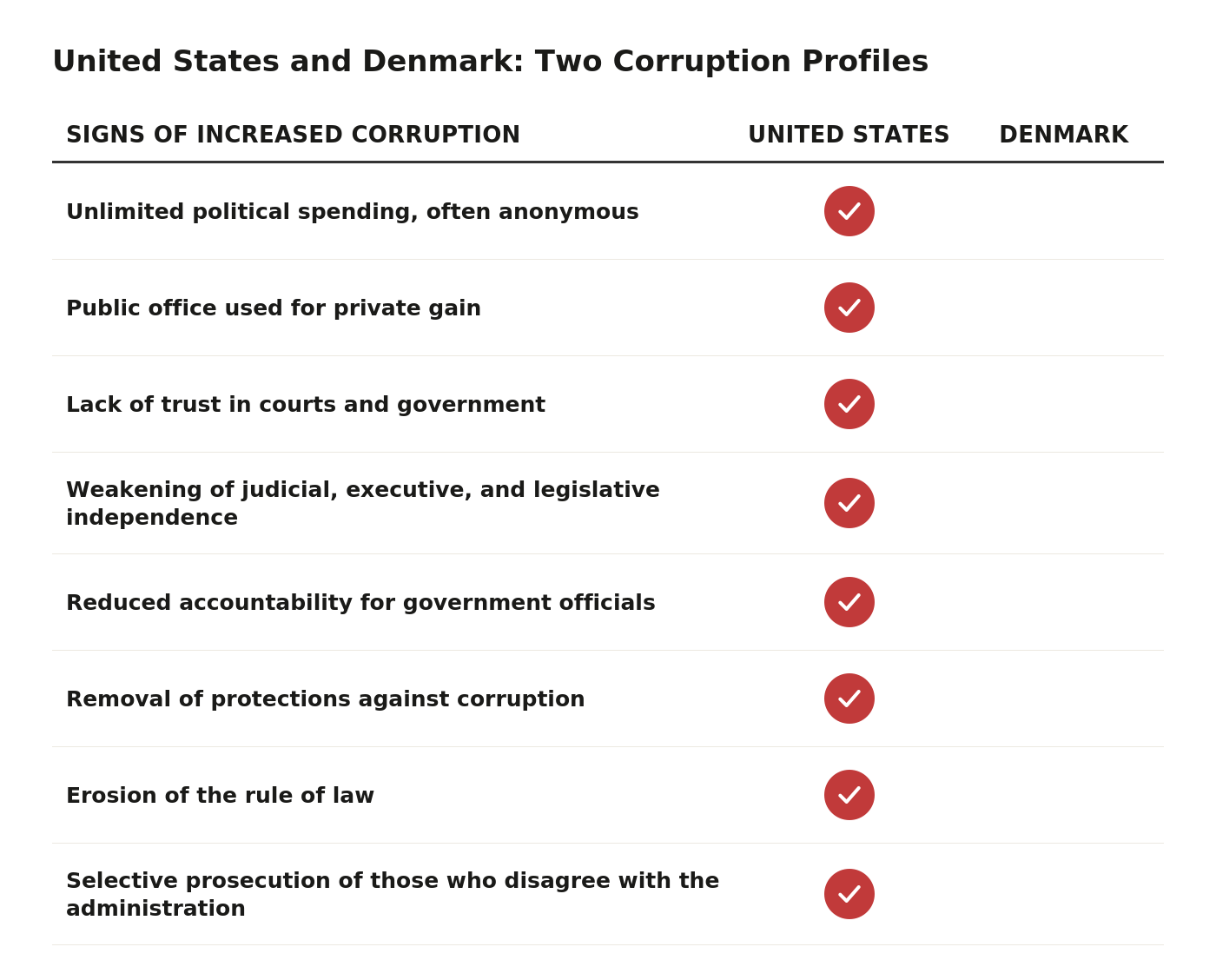
Chart shows difference between a “clean country” (Denmark") and a country with government corruption (the United States).
Warning Signs of Rising Structural and Actual Corruption
The 2025 US Transparency International report pointed to the following structural government changes and warning signs showing more government corruption in the United States:
reduced oversight and enforcement of corruption
weakened checks and balances
increased political influence on oversight institutions
threats to judicial independence in the US Supreme Court and federal judiciary.
Comparing Denmark (least corrupt in the world) and the US (becoming more corrupt each year) demonstrates the structures needed to prevent corruption and the conditions which enable corruption to flourish. Denmark has intentionally created and retained structures that starve corruption — competitive bidding, independent courts, real accountability of government, enforcement and investigation into public corruption. In contrast, the US has weakened or removed checks on corruption, each red check marks indicating a weakening or lost guardrail.
The CPI identified recent developments in the US which seem to point to further corruption:
While the 2025 data have yet to fully reflect all developments from 2025, specific actions, such as the use of public office to target independent voices and the undermining of judicial independence, raise troubling concerns. Beyond the CPI findings, the temporary freeze and weakening of enforcement of the Foreign Corrupt Practices Act signal tolerance for corrupt business practices, while cuts to US aid for overseas civil society have weakened global anti-corruption efforts.
In discussing the results, Transparency International focused on the US government using its power for politically motivated reasons:
Reflecting on the score of 64, Transparency International U.S. points to the dangerous misuse of government authorities originally established for politically neutral enforcement of laws and regulations. Increasingly, these authorities have been applied in ways that raise serious concerns about selective and politically motivated enforcement.
Maíra Martini, the CEO of Transparency International stated:
We are very concerned about the situation in the United States. This declining trend might continue.
These are serious warnings from corruption experts. Further, in 2026, selective and politically and personally motivated enforcement of laws and powers has continued. These include wasteful no-bid contracts given to insiders, promised pardons for anyone “within 200 feet of the White House”, and countless other acts of public corruption, including the IRS settling President Trump’s lawsuit with Trump’s DOJ, permanently barring the IRS from auditing his, his family's, or his companies’ past tax returns.
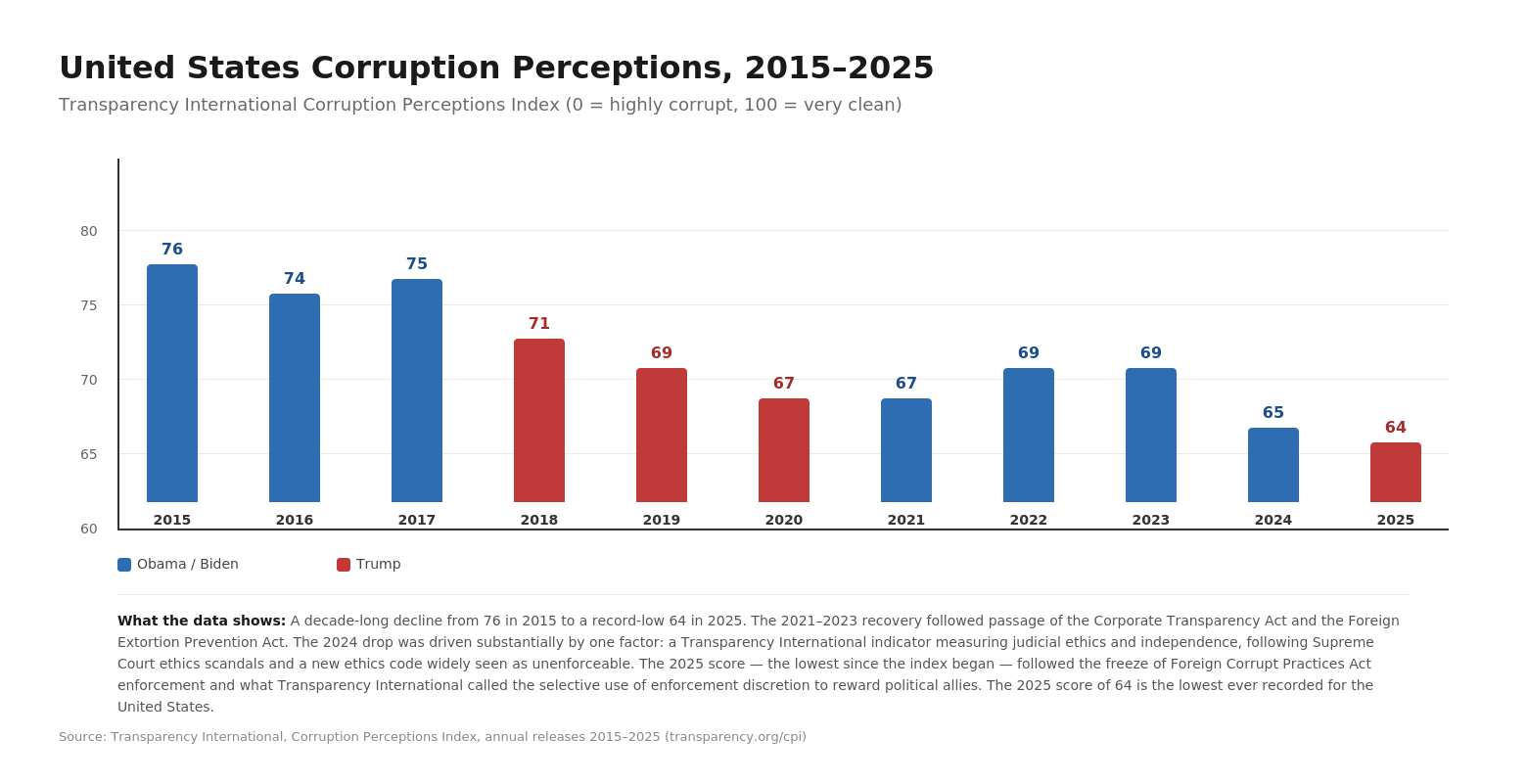
Chart showing trending poorer performance on corruption index for the US.
Perceptions of Government Corruption Have Negative Consequences
The United States’ ratings in the CPI have been trending more corrupt since 2017. Over the past ten years, the United States has dropped from a score of 76, ranking 16th in 2015, to a score of 64, ranking 29th, in 2025.
Global perception of public corruption has consequences, including reduced interest in doing business in and investing in a country perceived as corrupt, along with a lack of trust in a corrupt country by other world leaders. Eonomists have found that a country's slide toward corruption can deter foreign investment as much as a 21-percentage-point tax increase would, as capital moves toward countries where rules and courts are predictable and fair. Since 2025, the United States has forfeited its standing as a check on corruption elsewhere — Transparency International notes that the US freeze on Foreign Corrupt Practices Act enforcement and cuts to anti-corruption aid have weakened global anti-corruption efforts.
Corruption also matters to a populace who does not trust its government, who sees their tax dollars frittered away in wasteful government contracts, special treatment for insiders, and selective prosecution against those who do not fall in line with the government. National happiness correlates with clean governments, and personal unhappiness correlates with corruption.
Not all countries or politicians are corrupt. None are perfect. Some have cleaner, less compromised governments than others, and it matters.
Some of these worrisome changes have come rapidly, including democratic backsliding, selective prosecution of laws, reduction of protection against government corruption, and the erosion of the rule of law.
The current American government is not acting according to the enlightenment ideals on which the US was founded, including the ideas that nobody is above the law and that “justice” is administered equally, without fear or favor.
Something is not rotten in the state of Denmark. But there is a distinct and dangerous corruption stench in the United States.
For More Information:
General sources
Transparency International: U.S. government perceived as increasingly corrupt
CampaignLegal.org: The Significance of Firing Inspectors General: Explained
Reuters: Record High In the United States Say Corruption is Widespread
Undoing Accountability: An Update on Trump’s Attack on Inspectors General
The Atlantic: How America Chose Not to Hold: Our National Project Toward Elite Impunity
Michigan State, International Law Review: Citzens United: An International Anomaly
NDTV: "US Slips To Lowest-Ever Rank In Global Corruption Index, Denmark Tops List Again"
Unlimited political spending, often anonymous
Brennan Center for Justice: Citizens United, Explained
Lack of trust in courts and government
Washington Post: US Hits New Low On Corruption Amid Concerns Over the Courts
Reduced accountability for government officials
Supreme Court official “Immunity: opinion (PDF): https://www.supremecourt.gov/opinions/23pdf/23-939_e2pg.pdf
SCOTUSblog: Justices rule Trump has some immunity from prosecution
Brennan Center: The Supreme Court's Presidential Immunity Ruling Undermines Democracy
Removal of protections against corruption
NPR "Trump fires inspectors general
ABC News: Trump fires 17 independent watchdogs at multiple agencies in late-night move
VOA News: US Justice Department disbands teams investigating corruption, election interference
Paul, Weiss: FCPA Enforcement and Anti-Corruption Developments: 2025 Year in Review
Paul, Weiss: SEC Enforcement: 2025 Year in Review
Erosion of the rule of law
CRS Report R48980, Noncompetitive Federal Contract Awards
The Hill: On the Foreign Influence Task Force's dissolution
Selective prosecution / pardons of allies
CREW: Trump has granted clemency to 20 corrupt politicians—so far
NPR: Trump pardons, DOJ moves hurt fight against public corruption
NPR: What's behind Trump's pardons of people convicted of public corruption?
Comparisons to Denmark
Library of Congress "FALQs: Impeachment Rules in Denmark
JURIST, on the Støjberg conviction
OECD: Anti-Corruption and Integrity Outlook 2026 — Denmark
Chambers Practice Guides: Anti-Corruption 2026 — Denmark
